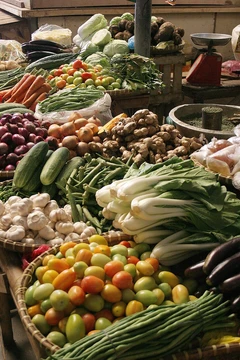
Choy sum
A leafy vegetable with yellow flowers, used in Chinese cuisine.

Wikipedia / Wikimedia Commons
Choy sum, also called Chinese flowering cabbage, is a leafy green in the mustard family, genus Brassica. Its Cantonese name, often spelled choi sum or choi sam, translates to "heart of the vegetable," and in Standard Mandarin it is known as caixin. It is also referred to as yu choy.
The plant resembles gai lan, with distinct yellow flowers. Each flower has four yellow petals, oval to round, and six stamens. The stems are fleshy and erect, 0.5 to 1 centimeter thick and 15 to 20 centimeters tall. The leaves are light to dark green, oval (becoming pointed or basal-shaped near flowering), with slightly serrated edges, and never form compact heads like cabbage. Fruits develop from cross- or self-pollination, appearing as siliques that open when dry to release small, round brown or black seeds. A single pod can hold 4 to 46 seeds.
Plant height ranges from 10 to 40 centimeters, depending on growing conditions and variety. Flowering typically begins when the plant has 7 to 8 leaves or reaches about 20 centimeters tall. Most roots are within 12 centimeters of the surface and spread within a 12-centimeter radius. The plant is generally an annual herb, rarely perennial or subshrub-like, with a simple or branched leafy structure. It grows best in soil with a pH between 5.6 and 7.5.
Choy sum is highly valued as a vegetable in China and Japan. It is commonly eaten in soups, blanched, or stir-fried.
- scientific_name
- Brassica rapa var. parachinensis or Brassica chinensis var. parachinensis
- family
- Brassicaceae
- height_range
- 10 to 40 cm (4 to 16 in)
- flower_color
- yellow
- seed_pod_seed_count
- 4 to 46 seeds per pod
- optimal_soil_pH
- 5.6 to 7.5
Lore & Background
Choy sum is a green leafy vegetable similar to gai lan, characterized by distinct yellow flowers, each with four yellow, oval to round petals and six stamens on fleshy, erect stems. The stems are 0.5 to 1 cm in diameter and 15 to 20 cm tall, with light to dark green leaves that are oval with slightly serrated margins and never form compact heads like cabbage. Fruits develop from cross-pollination or self-pollination and are silique structured, opening at maturity through dehiscence or drying to release small, round brown or black seeds.
Reader's Guide
Choy sum is highly valued as a vegetable in China and Japan, commonly consumed in soup, blanched, or stir-fried. The plant is an annual, herbaceous plant, rarely perennial or subshrub, with a simple or branched leafy structure. It grows best in soil with a pH between 5.6 and 7.5. The height varies from 10 to 40 cm depending on growing conditions and variety, with flowering usually appearing when there are about 7 to 8 leaves or the plant is about 20 cm tall. The root system is confined to a depth and radius of about 12 cm. Its significance lies in its widespread use in East Asian cuisines and its botanical distinctiveness as a flowering Brassica.
Did You Know?
- Choy sum is a transliteration of the Cantonese name, which literally translates as 'heart of the vegetable'.
- Each flower has four yellow petals and six stamens.
- A single seed pod can bear 4 to 46 seeds.
- The plant's root system is confined to a depth and radius of about 12 cm.
Frequently Asked Questions
Who is Choy sum?
Choy sum is a leafy green vegetable belonging to the mustard family (Brassicaceae), with the scientific name Brassica rapa var. parachinensis. Its Cantonese name is often rendered as choi sum or choi sam and translates to 'heart of the vegetable,' while Mandarin speakers call it caixin.
What does Choy sum look like?
It has fleshy, upright stems roughly half to one centimeter thick, topped with oval leaves that range from light to dark green. The plant is crowned with small yellow blooms, each carrying four oval petals and six stamens.
How tall does Choy sum grow?
The whole plant typically stands between 10 and 40 centimeters (about 4 to 16 inches) tall. Individual stems measure around 15 to 20 centimeters in length.
What is Choy sum's role in the kitchen?
It is a widely used leafy green in Chinese cooking, prized for its tender stems and mild, slightly sweet flavor. The small yellow flowers are also edible and add a bright visual accent to stir-fries and steamed preparations.
What growing conditions does Choy sum prefer?
It does best in soil with a pH between 5.6 and 7.5. Once it sets seed, each pod can hold anywhere from 4 to 46 seeds.
More in Fruits & Vegetables 1-24
Spotted an error? Know more?
This is a living reference — every entry is fact-audited, and reader corrections feed straight into our audit queue. Suggest an edit · See this site's audit record