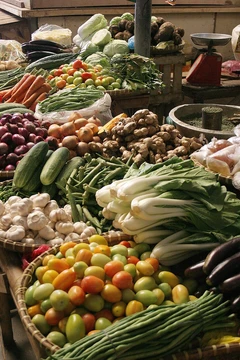
Cucumber
A widely-cultivated creeping vine plant with cylindrical fruits.

Wikipedia / Wikimedia Commons
The cucumber (Cucumis sativus) is a popular annual vine from the gourd family, known for its cylindrical or round fruits that are commonly used as a vegetable in cooking. It comes in three main types: those meant for slicing, those for pickling, and seedless varieties. Native to a region of Asia spanning India, Nepal, Bangladesh, parts of southern China, and northern Thailand, the cucumber now grows on most continents and is commercially cultivated worldwide. People have been growing cucumbers for at least 3,000 years; Roman Emperor Tiberius had them available year-round, Charlemagne ordered them cultivated in the Middle Ages, and Spanish explorers introduced them to the Americas in 1494 during the Columbian exchange. Today, China leads global production, accounting for more than three-quarters of the total.
- Scientific name
- Cucumis sativus
- Family
- Cucurbitaceae
- Origin
- Asia (India, Nepal, Bangladesh, China, Northern Thailand)
- Cultivation started
- At least 3,000 years ago
- Chromosome number
- 2N=14
- Water content
- 95%
- World production (2024)
- 88 million tonnes, led by China (78%)
Lore & Background
The cucumber is an annual creeping vine that roots in the ground and grows up trellises or other supporting frames, wrapping around supports with thin, spiraling tendrils. The plant can root in a soilless medium, then sprawl along the ground in the absence of a supporting structure. The vine has large leaves that form a canopy over the fruits. The fruit of typical cultivars of cucumber is roughly cylindrical, but elongated with tapered ends, and may be as large as 62 centimeters (24 in) long and 10 centimeters (4 in) in diameter. Cucumber fruits consist of 95% water. In botanical terms, the cucumber is classified as a pepo, a type of botanical berry with seeds and an outer rind. In a culinary context, it is considered a vegetable.
Most cucumber cultivars are seeded and require pollination. For this purpose, thousands of honey beehives are carried to cucumber fields each year just before bloom. Cucumbers can be pollinated by bumblebees and several other wild bee species. Most cucumbers that require pollination are self-incompatible, thus requiring the pollen of another plant in order to form seeds and fruit. Some self-compatible cultivars exist that are related to the 'Lemon cucumber' cultivar. Some cultivars are parthenocarpic, creating seedless fruit without pollination; these are often grown in greenhouses. However, fruit set is significantly higher when bees visit the flowers. Traditional cultivars produce male blossoms first, then female, in about equivalent numbers. Newer gynoecious hybrid cultivars produce almost all female blossoms.
Phytochemicals in cucumbers may discourage natural foraging by herbivores, such as insects, nematodes or wildlife. As a possible defense mechanism, cucumbers produce cucurbitacin C, which causes a bitter taste in some cucumber varieties. This potential mechanism is under preliminary research to identify whether cucumbers are able to deter herbivores and environmental stresses by using an intrinsic chemical defense, particularly in the leaves, cotyledons, pedicel, carpopodium, and fruit.
Reader's Guide
The cucumber has been cultivated for at least 3,000 years, with domestication in India from wild Cucumis sativus var. hardwickii. It was probably introduced to Europe by the Greeks or Romans. Records of cucumber cultivation appear in France in the 9th century, England in the 14th century, and in North America by the mid-16th century. According to Pliny the Elder, the Emperor Tiberius had the cucumber on his table daily during summer and winter, using artificial growing methods with frames glazed with mirrorstone. Charlemagne had cucumbers grown in his gardens in the 8th/9th century. The Spaniards brought cucumbers to Haiti in 1494. In 2024, world production of cucumbers and gherkins was 88 million tonnes, led by China with 78% of the total. Cucumis sativus was described by Carl Linnaeus in 1753 in his Species Plantarum. In 2009, the cucumber genome was sequenced. The three main cultivar groups are slicing, pickling, and seedless/burpless. Cucumbers are used fresh, pickled, and in various culinary preparations. The slightly bitter taste of cucumber rind results from cucurbitacins. The polyphenol content is higher in unpeeled cucumbers. Burpless cucumbers are sweeter and have a thinner skin, often grown in greenhouses and shrink-wrapped in plastic.
Did You Know?
- The cucumber is 95% water.
- Roman Emperor Tiberius had cucumbers on his table daily, using artificial growing methods with mirrorstone.
- Charlemagne had cucumbers grown in his gardens in the 8th/9th century.
- In 2024, China produced 78% of the world's cucumbers and gherkins.
Frequently Asked Questions
What is a cucumber?
A cucumber is an annual creeping vine in the gourd family (Cucurbitaceae) that bears cylindrical or round fruits. Although botanically classified as a fruit, it is most often treated as a vegetable in everyday cooking. Its scientific name is Cucumis sativus.
Where did cucumbers originally come from?
Cucumbers are native to a broad stretch of South and Southeast Asia, spanning India, Nepal, Bangladesh, parts of southern China, and northern Thailand. From that homeland, cultivation eventually reached nearly every continent on Earth.
What are the main types of cucumbers?
There are three primary categories: slicing cucumbers bred for fresh eating, pickling cucumbers designed for preservation, and seedless varieties. Each type is cultivated and selected for a slightly different culinary use.
How long have humans been growing cucumbers?
Evidence points to at least 3,000 years of deliberate cultivation. Roman Emperor Tiberius reportedly enjoyed them year-round, and Charlemagne later ordered their growth across his estates.
What is notable about a cucumber's biology?
Cucumbers carry a chromosome number of 2N=14 and are composed of roughly 95% water. They sit in the Cucurbitaceae family alongside melons, squashes, and watermelons.
More in Fruits & Vegetables 1-24
Spotted an error? Know more?
This is a living reference — every entry is fact-audited, and reader corrections feed straight into our audit queue. Suggest an edit · See this site's audit record