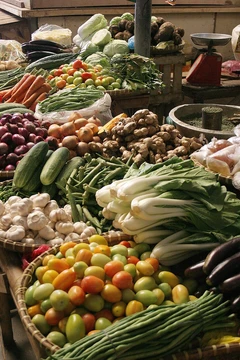
Cooking banana
Starchy banana cultivars used primarily in cooking worldwide.

Wikipedia / Wikimedia Commons
Cooking bananas are a category of banana cultivars from the genus *Musa* that are typically used in cooking rather than eaten raw. They are starchy, and many are commonly called plantains or green bananas. Botanically, the term "plantain" refers only to true plantains—cooking cultivars from the AAB group—while other starchy cooking varieties are simply called cooking bananas. These cooking cultivars can belong to the AAB, AAA, ABB, or BBB groups, and all are now classified under the scientific name *Musa × paradisiaca*. Fe'i bananas (*Musa × troglodytarum*), found in the Pacific Islands, are often roasted or boiled and informally called mountain plantains, though they are not descended from the same species as modern banana cultivars.
These bananas are a key staple food in West and Central Africa, the Caribbean, Central America, and northern South America. The *Musa* genus is native to tropical Southeast Asia and Oceania. Because bananas fruit year-round, they provide a dependable food source in all seasons.
Cooking bananas are treated as a starchy fruit with a mild flavor and soft texture when cooked. While they can be eaten raw, they are most often fried, boiled, or processed into flour or dough. Plantains have more starch and less sugar than dessert bananas, which is why they are usually cooked. Green plantains are typically boiled or fried; their pulp is hard, and the peel is stiff enough to require a knife. Mature yellow plantains can be peeled by hand like dessert bananas, and their pulp is softer and slightly sweeter due to starch converting to sugar. They can be eaten raw but are less flavorful than dessert bananas, so they are usually cooked. When fried, yellow plantains caramelize to a golden-brown color. They can also be boiled, baked, microwaved, or grilled, either peeled or unpeeled.
Plantains rank as the tenth most important staple food worldwide. In tropical regions, they are used similarly to potatoes, with a neutral flavor and texture when unripe and cooked by steaming, boiling, or frying. Their year-round fruiting makes them a reliable staple, especially in developing countries with limited food storage and transportation. In Africa, plantains and bananas supply over 25 percent of daily calories for more than 70 million people. Plantain plantations are vulnerable to hurricanes, as *Musa* species cannot withstand high winds. An average pl
- Scientific name
- Musa × paradisiaca
- Genome groups
- AAB, AAA, ABB, BBB
- Major staple regions
- West and Central Africa, Caribbean, Central America, northern South America
- Indigenous region
- Tropical Southeast Asia and Oceania
- Energy per average plantain
- About 920 kJ (220 kcal)
- Key nutrients
- Potassium and dietary fiber
Lore & Background
Cooking bananas are treated as a starchy fruit with a relatively neutral flavor and soft texture when cooked. They may be eaten raw, but are most commonly prepared either fried, boiled, or processed into flour or dough. Plantains have more starch and less sugar compared to regular bananas, which is why they are mostly cooked before eating. They are typically boiled or fried when eaten green, and when processed, they can be made into flour and turned into baked products such as cakes, bread and pancakes. Green plantains can also be boiled and pureed and then used as thickeners for soups. The pulp of green plantain is typically hard, with the peel often so stiff that it must be cut with a knife to be removed. Mature, yellow plantains can be peeled like typical dessert bananas; the pulp is softer than in immature, green fruit and some of the starch has been converted to sugar. They can be eaten raw, but are not as flavorful as dessert bananas, so are usually cooked. When yellow plantains are fried, they tend to caramelize, turning a golden-brown color. They can also be boiled, baked, microwaved, or grilled over charcoal, either peeled or unpeeled.
Reader's Guide
Cooking bananas are a major food staple in West and Central Africa, the Caribbean islands, Central America, and northern South America. They fruit all year round, making them a reliable all-season staple food, particularly in developing countries with inadequate food storage, preservation, and transportation technologies. In Africa, plantains and bananas provide more than 25 percent of the caloric requirements for over 70 million people. Plantain plantations are vulnerable to destruction by hurricanes, because Musa spp. do not withstand high winds well. An average plantain provides about 920 kilojoules (220 kilocalories) of food energy and is a good source of potassium and dietary fiber. The sap from the fruit peel, as well as the entire plant, can stain clothing and hands, and can be difficult to remove. As a staple, plantains are treated in much the same way as potatoes, with a similar neutral flavor and texture when the unripe fruit is cooked by steaming, boiling, or frying. They rank as the tenth most important staple food in the world. Their significance lies in their year-round availability, nutritional value, and versatility in numerous traditional dishes across tropical regions.
Did You Know?
- Cooking bananas are not eaten raw and are generally starchy.
- The currently accepted scientific name for all cooking banana cultivars is Musa × paradisiaca.
- In Africa, plantains and bananas provide more than 25 percent of the caloric requirements for over 70 million people.
- An average plantain provides about 920 kilojoules (220 kilocalories) of food energy.
Frequently Asked Questions
Who is Cooking banana?
Cooking banana is not a single species but a broad category of starchy Musa cultivars, all now grouped under the scientific name Musa × paradisiaca. They are set apart from sweet dessert bananas by their high starch content and the expectation that they are cooked before eating.
What are Cooking banana's powers/role?
In the kitchen, cooking bananas act as a versatile starch base that can be fried, boiled, baked, or mashed into porridges. Their dense, low-sugar flesh holds up well under heat, which is why they anchor everyday meals across West and Central Africa, the Caribbean, and Central America.
How does Cooking banana's story end?
Rather than being consumed raw, a cooking banana's final act is on the plate—sliced and pan-fried until golden, mashed into a thick porridge, or baked as a hearty side. One average plantain delivers roughly 220 kcal of energy, so it typically closes out a full meal rather than serving as a quick snack.
Why is Cooking banana important?
Cooking bananas are a primary caloric source for hundreds of millions of people in tropical regions, supplying both substantial energy and key nutrients such as potassium and dietary fiber. Their hardiness as a crop makes them a cornerstone of food security in West Africa, the Caribbean, and northern South America.
Where does Cooking banana come from?
The lineage of cooking bananas traces back to tropical Southeast Asia and Oceania, where wild Musa species were first domesticated. From that ancestral homeland, cultivars spread through trade routes and migration to become the starchy backbone of diets in Africa, the Caribbean, and the Americas.
More in Fruits & Vegetables 1-24
Spotted an error? Know more?
This is a living reference — every entry is fact-audited, and reader corrections feed straight into our audit queue. Suggest an edit · See this site's audit record