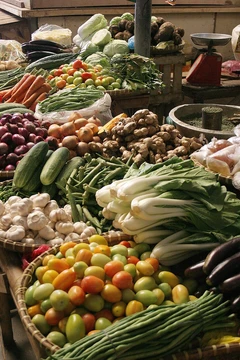
Kabocha
A sweet winter squash of Japanese origin, versatile in cooking.
Kabocha is a type of winter squash, a Japanese variety of the species Cucurbita maxima, also known as kabocha squash or Japanese pumpkin in North America. It is hard on the outside with knobbly skin, often dark green, red-orange, or gray, and has an intense yellow-orange interior. Kabocha is notable for its exceptionally sweet flavor, even sweeter than butternut squash, and is used in a wide range of culinary applications from tempura to desserts.
- species
- Cucurbita maxima
- also called
- Kabocha squash, Japanese pumpkin
- average weight
- 2–3 pounds (1–1.5 kg)
- peak season
- Late summer and early fall
- primary growing regions
- Japan, South Korea, Thailand, California, Florida, Hawaii, Southwestern Colorado, Mexico, Tasmania, Tonga, New Zealand, Chile, Jamaica, South Africa
- key nutrients
- Beta carotene, iron, vitamin C, potassium
Lore & Background
Portuguese sailors introduced kabocha to Japan in 1541, bringing it from Cambodia. The Portuguese name Camboja abóbora was shortened by the Japanese to kabocha; alternatively, the Portuguese word cabaça for gourd may be the origin. In Japan, kabocha can refer to this squash, the Western pumpkin, or other squashes. In Australia, 'Japanese pumpkin' is a synonym of Kent pumpkin, a variety of C. moschata. Many kabocha in the market are kuri kabocha, a type created from seiyo kabocha (buttercup squash). Varieties include Ajihei, Ebisu, Emiguri, Marron d'Or, and Miyako.
Reader's Guide
Kabocha is widely cultivated in Japan, South Korea, Thailand, parts of the United States, Mexico, Tasmania, Tonga, New Zealand, Chile, Jamaica, and South Africa, and is adapted to climates with a growing season of 100 days or more. Most kabocha grown in California, Colorado, Tonga, and New Zealand is exported to Japan. In Japan, it is used in vegetable tempura, soup, croquettes, and desserts such as pies, pudding, and ice cream. In Korea, danhobak is used for hobak-juk (pumpkin porridge). In Thailand, fak thong appears in traditional desserts and main courses; in Jamaica, it is used in chicken foot soup. The squash is rich in beta carotene, iron, vitamin C, and potassium. Ripening is a deliberate process: after harvest, kabocha is kept warm for 13 days to convert starch to sugar, then stored cool for about a month to increase carbohydrate content, reaching peak ripeness 1.5–3 months after harvest. All squashes were domesticated in Mesoamerica, with evidence suggesting domestication 8,000 to 10,000 years ago.
Did You Know?
- Kabocha was introduced to Japan by Portuguese sailors in 1541, who brought it from Cambodia.
- The rind of kabocha is edible, though some cooks peel it for texture or speed.
- Kabocha is best in late summer and early fall, though available all year.
- Fully ripened kabocha has reddish-yellow flesh, hard skin, and a dry, corky stem.
Frequently Asked Questions
What is Kabocha?
Kabocha is a Japanese winter squash belonging to the species Cucurbita maxima, commonly called Japanese pumpkin or Kabocha squash in North America. It features a tough, knobbly rind in shades of dark green, red-orange, or gray, wrapping a vivid yellow-orange flesh inside.
How does Kabocha taste compared to other squashes?
Kabocha is prized for its notably sweet flavor, edging out even butternut squash in sweetness. This rich, almost caramel-like taste makes it a favorite in everything from savory tempura batter to sweet desserts.
When is Kabocha at its peak?
The best time to find Kabocha at its sweetest is during late summer and early fall. A typical specimen weighs around two to three pounds (roughly 1 to 1.5 kg).
Where is Kabocha grown?
While it originated in Japan, Kabocha is now cultivated across South Korea, Thailand, Mexico, and parts of South America, as well as in U.S. states like California, Florida, Hawaii, and Southwestern Colorado. It also sees commercial production in Tasmania, New Zealand, Tonga, Jamaica, and South Africa.
What key nutrients does Kabocha pack?
Kabocha is a dense source of beta carotene, iron, vitamin C, and potassium. Its intense orange flesh is a visual giveaway of that high carotenoid content, making it a nutritionally robust choice for any meal.
More in Fruits & Vegetables 1-24
Spotted an error? Know more?
This is a living reference — every entry is fact-audited, and reader corrections feed straight into our audit queue. Suggest an edit · See this site's audit record